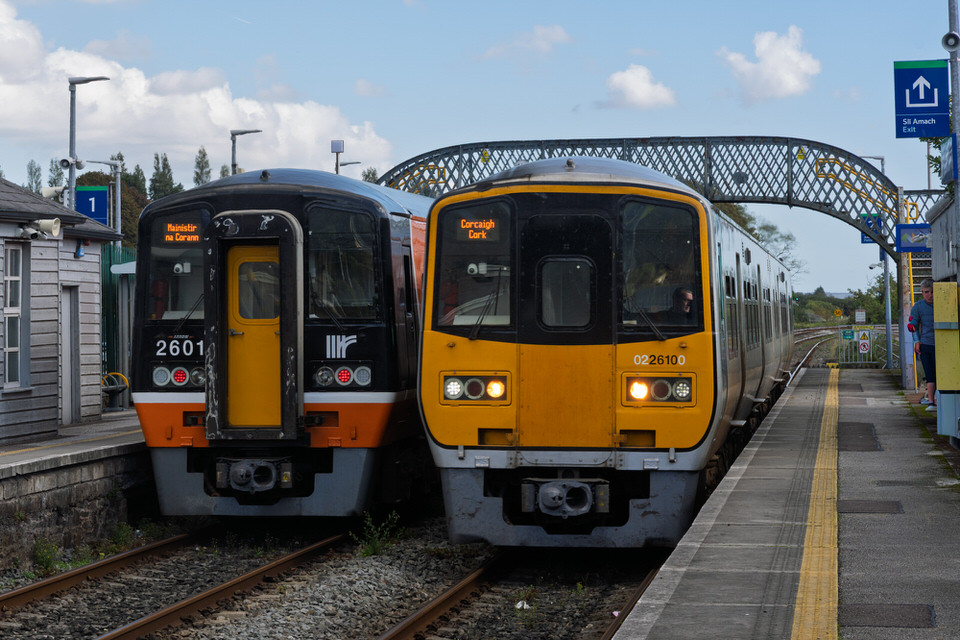
CORK SEPTEMBER 2025


ARROW TRAIN SETS AT GLOUNTHAUNE RAILWAY STATION [CORK SEPTEMBER 2025]
The Arrow’s Second Quiver: The Story of the IÉ 2600 Class
A New Generation for Irish Rail
In the early 1990s, Iarnród Éireann (IÉ) stood at a critical juncture. Its non-electrified passenger services were dominated by locomotive-hauled trains, a method ill-suited for the growing demands of suburban commuter traffic. The network was emerging from a period of managed decline and was in profound need of modernisation. It was against this backdrop that IÉ made a landmark decision: the procurement of the 2600 Class Diesel Multiple Units (DMUs). This was the first step in the comprehensive “railcarisation” of the Irish network, a strategic shift that would redefine passenger services for a generation.
Before 1994, modern diesel railcars were a distant memory. The last major fleet, the original AEC 2600 Class from the 1950s, had been withdrawn by the late 1980s. This left IÉ relying on ageing locomotives and carriages, which were inefficient for the quick turnarounds required for commuter operations. The success of the electrified Dublin Area Rapid Transit (DART) system had highlighted the benefits of modern multiple-unit trains, but a new solution was urgently needed for the rest of the network.
In 1993, IÉ placed an order worth IR£19.5 million for seventeen railcars from the Tokyu Car Corporation of Japan. This was a decision of profound strategic importance. Historically, IÉ had sourced rolling stock from the UK and locomotives from the US. Partnering with a Japanese manufacturer represented a deliberate pivot, a global search for best-in-class technology. This move not only globalised IÉ’s supply chain but also set a crucial precedent for future fleet orders from Spain and South Korea. The new fleet arrived at Dublin Port on 14 February 1994, ready to begin a new chapter for Irish Rail. 🚂
The arrival of the 2600 Class was the physical manifestation of the new “railcarisation” philosophy. DMUs offered faster acceleration, quicker turnarounds at termini, and the flexibility to match train length to passenger demand. They were the spark that ignited the gradual modernisation of the entire Iarnród Éireann network.
Key Milestones
1993: Order for 17 railcars placed with Tokyu Car Corporation, marking the start of “railcarisation”.
14 Feb 1994: The fleet arrives at Dublin Port.
16 May 1994: The “Arrow” service is launched on the Dublin-Kildare line.
30 Jun 2003: The “Arrow” brand is renamed “Commuter” to coincide with the introduction of the new 29000 Class.
c. 2005-2010: The class is gradually displaced from primary Dublin duties by newer fleets.
30 Jul 2009: The Glounthaune-Midleton line reopens in Cork, a key future route for the fleet.
c. 2010: The entire 2600 Class fleet is permanently relocated to Cork.
Aug 2013: The fleet begins receiving the silver InterCity livery.
Nov 2022: Pragmatic removal of front gangway connections begins to reduce maintenance.
18-19 May 2024: A 30th Anniversary “Arrow” railtour is operated with set 2601/2602, specially repainted in its original livery.
Jul 2025: Railcar 2609 is scrapped, the first member of the class to be withdrawn.
The “Arrow” Takes Flight: Dublin (1994–c. 2010)
The introduction of the 2600 Class was intrinsically linked to the launch of the “Arrow”, a new brand designed to transform the image of suburban rail travel. For over a decade, these Japanese-built trains were the ubiquitous workhorses of the Greater Dublin Area network.
Launch of a Brand
On 16 May 1994, Iarnród Éireann officially launched the “Arrow” service on the newly upgraded Kildare line. This route saw significant investment, including reopened and new stations. The brand was applied not just to the train’s livery but to station signage, creating a unified and modern service identity. This was the first time a specific brand had been developed for diesel suburban services in Ireland, a clear move to elevate their public perception. The name itself—short, sharp, and evocative of speed—was a marketing masterstroke, successfully positioning the service as a completely new and superior travel option.
The Dublin Workhorse
While officially branded for the Kildare line, the versatile 2600 Class units were deployed across the entire Dublin non-electrified network. Their duties included:
Western Commuter: Services from Dublin Connolly to Maynooth.
Northern Commuter: Operations on the busy line to Drogheda and Dundalk, often in eight-car formations during peak hours.
Inter-regional Workings: On Sundays, they were frequently used on longer-distance auxiliary services to destinations like Galway and Waterford.
The “Celtic Tiger” Context
The service life of the 2600 Class in Dublin coincided almost perfectly with the “Celtic Tiger,” a period of unprecedented economic growth. This boom placed immense pressure on transport infrastructure. The fast, frequent, and reliable “Arrow” service was a critical piece of enabling infrastructure, making commuting from the expanding towns of the Kildare corridor a viable proposition for the first time. The fleet was a direct enabler of the economic and residential development that defined the era.
A Shift in Strategy: Fleet Modernisation and Cascading
The success of the 2600 Class ironically sowed the seeds for its own replacement in Dublin. By cultivating a surge in passenger demand, the service outgrew the capacity of the two-car sets, creating a compelling case for a new wave of fleet investment. The arrival of larger trains led to the strategic redeployment of the 2600 Class, a process known as “cascading”.
Arrival of New Fleets (2000-2011)
Between 2000 and 2011, Iarnród Éireann introduced three new classes of train that progressively took over from the 2600 Class in Dublin:
IÉ 2800 Class (2000): Built by Tokyu, these were mechanically similar and interoperable with the 2600s, providing crucial flexibility.
IÉ 29000 Class (2002–2005): These high-capacity, four-car DMUs from Spanish manufacturer CAF became the new backbone of Dublin’s commuter services.
IÉ 22000 Class “InterCity Railcar” (2007–2011): This transformative fleet from Hyundai Rotem in South Korea replaced locomotive-hauled stock on most InterCity routes and also operated on outer suburban services, rendering the 2600 Class surplus to Dublin’s requirements.
The Principle of Fleet Cascading
The transfer of the 2600 Class to Cork is a textbook example of fleet cascading. Instead of scrapping a reliable, mid-life fleet, an operator redeploys it from primary routes to secondary services where it is still highly suitable. This maximises the return on the original investment while ensuring the newest rolling stock is deployed on the busiest routes. The 2600 Class, though no longer large enough for Dublin, was perfectly suited to the expanding Cork network. This redeployment was a coordinated part of a long-term national transport strategy, with the final deliveries of the 22000 Class perfectly synchronised with the reopening of the Glounthaune-Midleton line in Cork in 2009.
A Second Life: Cork’s Suburban Workhorse
Following their withdrawal from the capital, the entire 2600 Class fleet was permanently relocated to Cork around 2010. Here, they became the backbone of the Cork Suburban Rail network, proving their enduring reliability and becoming a catalyst for regional growth.
The Cork Commuter Network
The 2600 Class operates on a network of three lines radiating from Cork’s Kent Station, forming a crucial part of the region’s public transport:
The Cork-Cobh Line: A scenic route following the harbour, serving communities and the popular Fota Wildlife Park.
The Cork-Midleton Line: Reopened in 2009, this line serves the rapidly growing satellite town of Midleton.
The Cork-Mallow Line: This line serves the town of Mallow to the north, completing the suburban rail triangle.
The eight two-car sets are ideally suited to these routes, typically running as two-car or four-car formations to match passenger demand. Their reliable performance has been instrumental in the network’s success, fostering significant growth in rail patronage. The National Transport Authority’s (NTA) 2023 Rail Census noted that patronage was still 29% higher than pre-pandemic levels, a testament to the service’s popularity. This success has cemented the rail corridors as fundamental pillars of the region’s future, with the Cork Metropolitan Area Transport Strategy (CMATS) 2040 calling for development to be concentrated around the existing lines. The fleet has not just moved people; it has actively shaped the future urban geography of Cork. 🏙️
Technical Profile and Fleet Evolution
The 2600 Class represents a durable and pragmatic design that has served Iarnród Éireann with remarkable longevity.
Core Specifications
Built in 1993 by Tokyu Car Corporation in Japan, the fleet entered service on 16 May 1994. The fleet originally consisted of 17 individual railcars, forming eight two-car sets with one spare. Each car is powered by a Cummins NTA-855-R1 diesel engine producing 260 kW (349 hp), coupled to a hydraulic transmission. This gives the trains a maximum speed of between 110 and 120 km/h (70-75 mph). A standard two-car set has a capacity of 130 seated passengers and weighs 84 tonnes. The units operate on Ireland’s 1,600 mm track gauge and are fitted with Dellner couplers.
Fleet Roster and Status (as of 2025)
The fleet’s operational history is one of pragmatic durability. The choice of robust Cummins engines simplified maintenance, a practical approach also evident in later modifications like the removal of front gangway connections between 2022 and 2023 to reduce costs.
Set 1 (2601/2602): Active. Repainted into original “Arrow” livery for its 30th anniversary (May 2024).
Set 2 (2603/2604): Active.
Set 3 (2605/2616): Active.
Set 4 (2606/2615): Active.
Set 5 (2607/2608): Active. Front gangway connections removed.
Set 6 (2610/2613): Active. Front gangway connections removed.
Set 7 (2611/2612): Active. Front gangway connections removed.
Set 8 (2614/2617): Active.
Vehicle 2609: Scrapped (July 2025).
A unique chapter was the “hybrid” set, where the spare 2600 Class car (No. 2609) was paired with the spare car from the later 2700 Class fleet. This anomaly ran mostly in Cork until 2012. After years in storage, vehicle 2609 became the first of the class to be scrapped. The fleet’s enduring significance was formally recognised in May 2024 with a special 30th-anniversary railtour, underscoring its important place in the heritage of modern Irish railways.
The End of the Line: The Future of Cork Rail
The very success of the 2600 Class in growing the Cork network has paved the way for a future in which it no longer has a role. The ambitious, multi-billion euro Cork Area Commuter Rail (CACR) programme is a direct result of the proven demand the fleet helped to build.
The Cork Area Commuter Rail (CACR) Programme
The CACR programme is the largest investment ever made in Cork’s rail network. It aims to dramatically increase capacity and frequency through:
Electrification: Full electrification of the core network from Mallow to Cobh and Midleton.
Increased Frequency: A “turn-up-and-go” service with trains every 10 minutes.
New Infrastructure: Including a new platform at Kent Station (opened April 2025), resignalling, twin-tracking the Midleton line, and building eight new stations.
New Fleet: Procurement of a new fleet of Electric Multiple Units (EMUs) from Alstom.
Inevitable Retirement
The implementation of the CACR makes the withdrawal of the 2600 Class a certainty. As a diesel fleet, it is incompatible with the planned overhead electrification. Furthermore, modern EMUs possess the superior acceleration required for the new high-intensity timetable. By the time the programme is realised, the fleet will be approaching 40 years of service, a typical operational lifespan. Its replacement is a natural part of the railway asset lifecycle.
A Legacy of Transformation
The biography of the IÉ 2600 Class is a direct reflection of Ireland’s economic and transport policy cycles over three decades. It was introduced as a symbol of modernisation, embodied the soaring demand of the Celtic Tiger, and enabled a cost-effective revival of Cork’s network. Its steadfast performance provided the foundation for the next wave of strategic, sustainability-focused investment.
The 2600 Class will be remembered for two vital roles: first, as the pioneering “Arrow” that redefined commuter rail in Dublin, and second, as the reliable workhorse that proved the case for the massive investment that will now define Cork’s future. It has served as a crucial and remarkably durable generational bridge, connecting the railway of the late 20th century to the electrified, high-frequency network of the 21st. 🌟