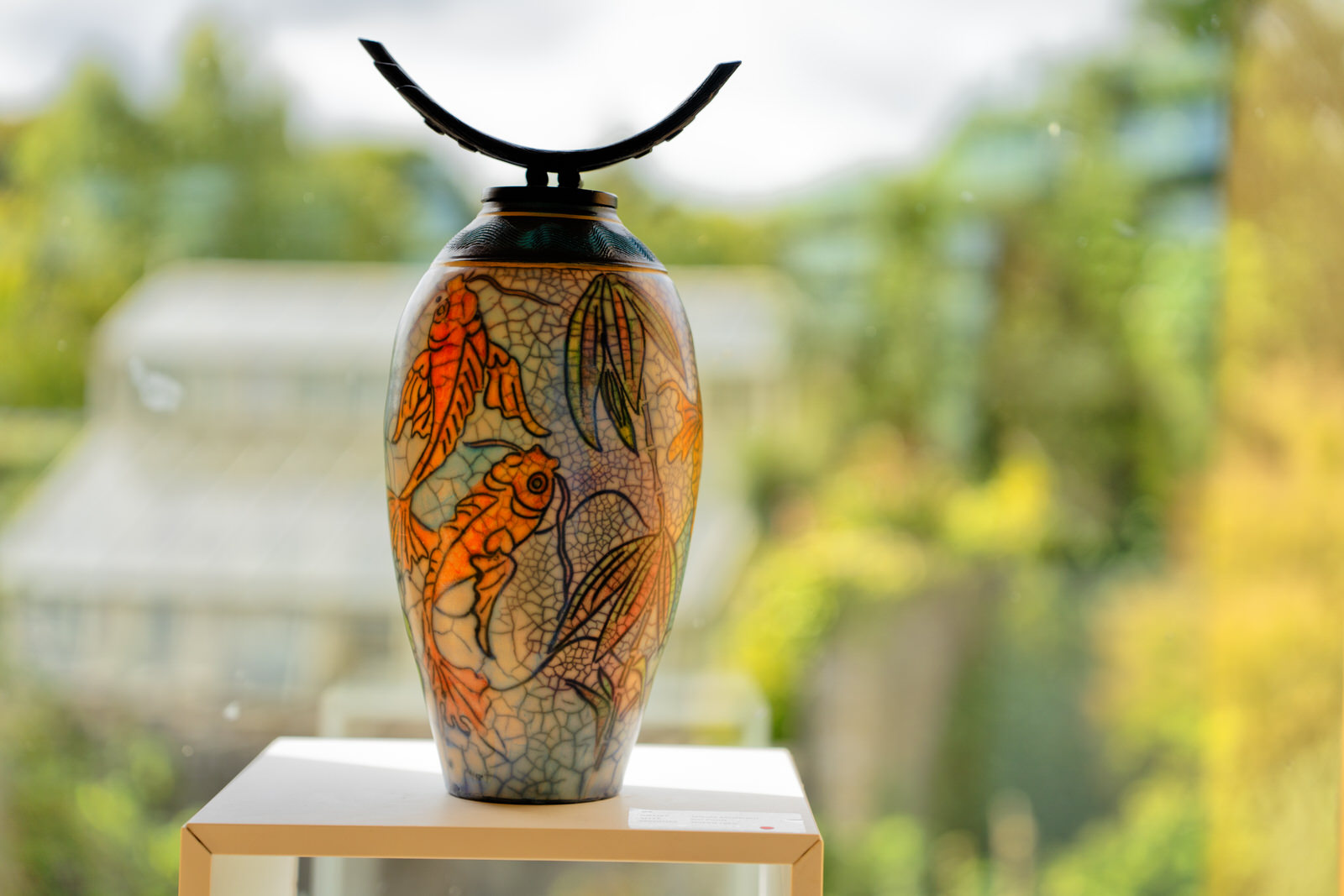


An accomplished Irish artist, Ursula McGivern is a celebrated ceramic sculptor known for her elegant forms and mastery of the raku firing technique. Her work, which has garnered national recognition, is characterised by a deep connection to the natural elements and a continual exploration of the transformative properties of clay.
A Career Forged in Clay
McGivern’s journey as a sculptor is one of dedicated evolution. After graduating from St Mary’s University College, Belfast, in 1978 with a specialisation in ceramics, she initially embarked on a 25-year career as a graphic designer and teacher. This background in design is evident in the refined aesthetic and balanced compositions of her sculptural work.
In 2010, a significant shift in her professional life saw her co-found Kildoag Pottery. This venture marked her full-time commitment to ceramic art, providing a dedicated space for her to hone her craft and develop her distinctive artistic voice.
A pivotal moment in her career arrived in 2023 when she was awarded the prestigious Irish Ceramic Award at the annual ‘Sculpture in Context’ exhibition held at the National Botanic Gardens in Dublin. This accolade was bestowed upon her for her remarkable piece titled ‘Industrial Architecture’, solidifying her position as a leading figure in contemporary Irish ceramics.
The Art of Raku and Elegant Forms
At the heart of McGivern’s artistic practice is the ancient Japanese firing technique of raku. This method, which involves removing the pottery from the kiln while still glowing hot and placing it in combustible materials, creates a unique and often unpredictable interplay of colours and textures on the glazed surface. McGivern’s work embraces this element of chance, with each piece bearing the distinct marks of the fire and smoke.
Her sculptures are predominantly wheel-thrown, favouring simple, elegant shapes that serve as a canvas for the intricate surfaces achieved through the raku process. This focus on form allows the viewer to fully appreciate the subtle crackle patterns and metallic sheens that are the hallmarks of her work. While her forms are often abstract, they are deeply influenced by the natural world, with the landscapes of the Derry countryside and the nearby beaches of Donegal providing a constant source of inspiration.
Beyond her acclaimed ‘Industrial Architecture’, other notable works include ‘Storm’, ‘Koi Pond’, and ‘Undulation 1’. These titles suggest a thematic concern with the elemental forces of nature and the fluid, organic forms found within it. Her work has been exhibited in both Ireland and the United Kingdom and is held in numerous private collections.